
An Giang is accelerating the development of the Khanh Binh Border Gate economy by investing in transport infrastructure, modernizing management, and driving digital transformation. This strategic move aims to boost agricultural exports from the Mekong Delta to Cambodia and the broader ASEAN market while ensuring robust border security.
The upgrading of Khanh Binh from a primary border gate to an international road border gate is expected to create new momentum for import-export activities, logistics, and cross-border trade between An Giang Province and Cambodia. Crucially, it positions Khanh Binh as a vital trade gateway connecting the rich agricultural production zones of the Mekong Delta with key regional markets.
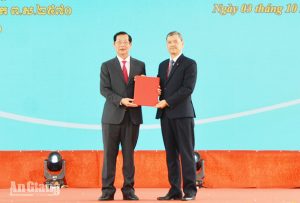
Upgrading Khanh Binh Border Gate to Drive Cross-Border Agri-Trade
Becoming an international border gate enables Khanh Binh to attract investment and expand commercial, service, and freight transport operations. Given that the Mekong Delta is Vietnam’s key agricultural hub—producing vast quantities of rice, fruits, and seafood—the upgrading of Khanh Binh provides a direct, cost-effective overland route for agricultural goods entering Cambodia and expanding further into the ASEAN region.
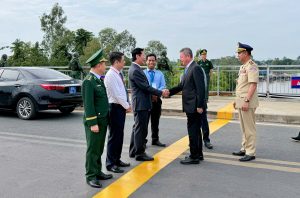
However, the surge in passenger flow, vehicles, and freight demands higher standards of border control and security management. On September 30, 2026, a delegation from the Border Guard Command led by Major General Tran Ngoc Huu, Deputy Commander, inspected the infrastructure and control facilities at Khanh Binh. The delegation emphasized organizational restructuring, professional capacity building, and the integration of advanced science and technology into border gate management.
Alongside administrative reforms, functional forces are tasked with tightening control to prevent smuggling, trade fraud, illegal transport of goods, narcotics, weapons, and unauthorized border crossings. The objective is to facilitate legitimate agricultural trade while maintaining a safe and stable border environment.
Investing in Transport Infrastructure, Logistics, and Digital Border Transformation
To maximize the commercial potential of the border gate economy, An Giang has identified transport infrastructure and logistics as core priorities. According to Nguyen Huu Suong, Deputy Standing Head of the An Giang Economic Zone Management Board, the province will advise on upgrading National Highway 91C, Provincial Road 957, and connecting routes, while designing optimized traffic and freight management solutions.
Improved transport infrastructure will streamline the movement of perishable agricultural products, reducing transit times and logistics costs for agribusinesses. Simultaneously, expanding warehousing and cold-chain logistics services will enhance the competitive edge of Khanh Binh in handling cross-border produce.
Ho Van Mung, Chairman of the An Giang Provincial People’s Committee, stated that the province is focused on modernizing border management through technology and digital transformation, working toward building a “smart and digital border gate.”
Data integration, process transparency, and efficient inspection workflows will significantly shorten customs clearance times. This allows agricultural exporters to preserve product freshness, lower overheads, and mitigate supply chain risks—establishing a modern management framework responsive to growing regional trade demands.
Khanh Binh – Chrey Thom: Targeting $1.2 Billion in Import-Export Turnover
The upgrade of the Khanh Binh – Chrey Thom international border gate pair opens expanded trade corridors linking An Giang with Cambodia and the broader ASEAN network. Under the province’s roadmap, total import-export turnover through this border gate pair is projected to reach approximately $1.2 billion by 2030.
To realize this goal, An Giang is strengthening linkages between the border gate, local industrial zones, and specialized agricultural production areas across the Mekong Delta. Synchronized transport, logistics, and supply chain networks will provide regional agribusinesses with favorable conditions to export fruits, rice, and processed foods into Cambodia and tap into broader regional markets.
Beyond driving agricultural export growth, a thriving border economy generates commercial opportunities, service jobs, and improved livelihoods for local border communities. As residents benefit directly from economic expansion, local support for maintaining security and public order along the border is further strengthened.
Economic Growth Hand-in-Hand with Border Security
Alongside economic objectives, An Giang remains committed to safeguarding national sovereignty and border security. Border agencies are instructed to proactively monitor developments, step up patrols, and strictly regulate cross-border movement of people, vehicles, and goods.
Le Van Phuoc, Vice Chairman of the An Giang Provincial People’s Committee, stressed that modernizing the border gate must yield tangible benefits for businesses, border forces, and local residents. Agribusinesses should benefit from streamlined procedures and lower operational costs; border control forces will benefit from enhanced monitoring capabilities; and local citizens will gain access to jobs and commercial opportunities in a safe, transparent environment.
Balancing economic development with defense and security is essential for ensuring stable, sustainable cross-border trade. With investments in transport infrastructure, cold-chain logistics, digital transformation, and regional cooperation, the Khanh Binh International Border Gate is set to become a vital bridge connecting Mekong Delta agriculture with Cambodia and the ASEAN market.
Source:
https://congan.com.vn
https://baomoi.com
Amasis Shipping Co., Ltd.
📞 +84 906 660 888
📩 info@amss.com.vn
🌍 www.amss.com.vn
🏘️27-29 Ngo Thi Bi Street, Tan Hung Ward, Hochiminh City