OVERVIEW DETAILS
VIETNAM
|
| Population (2025) |
101.38 million |
Country size |
331,210 km2 |
| Capital |
Hanoi |
Political system |
One-party communist state |
| Currency |
Vietnamese Dong (VND) |
Exchange Rate (03/2025) |
(VND/USD) 25,375 |
|
Joined in to WTO on January 2007
|
2023
GDP (2023): + 5.05%
Exports value 2023: USD 354.67 billion
(Decrease of 4.6% in comparison to 2022)
Import value in 2023: USD 326.37 billion
(Decrease of 9.2% in comparison to 2022)
Foreign Direct Investment (FDI) in 2023:
USD 23.2 billion (Increase 3.5% vs. 2022)
2024
GDP (2023): + 7.09%
Exports value 2024: USD 405.53 billion
(Increase of 14.3% in comparison to 2023)
Import value in 2024: USD 380. 76 billion
(Increase of 16.7% in comparison to 2023)
Foreign Direct Investment (FDI) in 2024:
USD 38.23 billion (Decrease 3% vs. 2023)
Free Trade Agreements (FTAs)
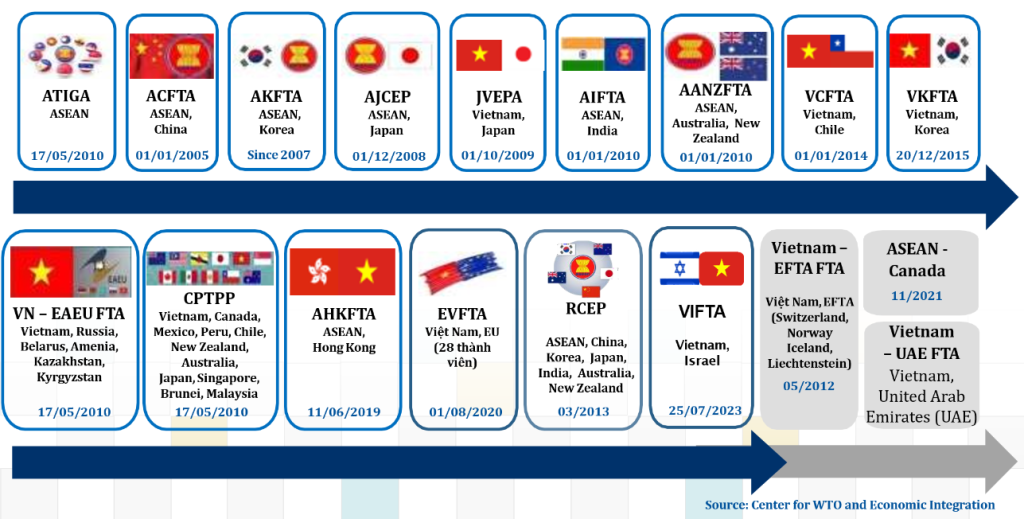
Vietnam has established trade agreements with various countries and economic regions to support international trade and economic cooperation.
The agreements listed in the profile include ATIGA, ACFTA, AKFTA, AJCEP, AIFTA, AANZFTA, VCFTA, VKFTA, VN–EAEU FTA, VJEPA, RCEP, CPTPP, EVFTA, AHKFTA, VIFTA, and the Vietnam–EFTA FTA.
The profile also identifies the ASEAN–Canada and Vietnam–UAE FTAs as agreements under negotiation at the time of preparation.
Foreign Direct Investment (FDI)
During the first six months of 2024, Vietnam recorded total FDI of approximately USD 15.19 billion, according to the profile. Investment covered 18 sectors, with manufacturing ranked first and real estate second. Investors from 84 countries and territories were represented.
Major projects highlighted include a liquefied natural gas (LNG) thermal power plant in Thai Binh, Jinko Solar’s photovoltaic cell technology complex in Hai Ha, Lite-On’s factory project in Quang Ninh, and LG Innotek’s factory project in Hai Phong.
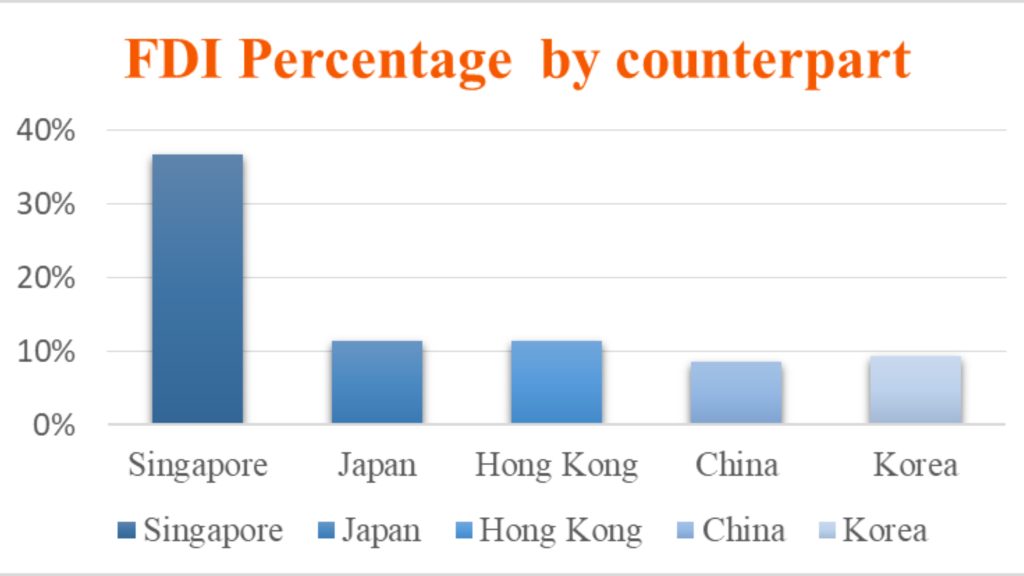
Singapore, Japan, Hong Kong, China, and South Korea were among the investment partners featured in the presentation.
2. Vietnam Market Overview
Vietnam maintains strong trading relationships with major international markets, including the United States, the European Union, China, ASEAN, Japan, and South Korea.
According to the profile, Vietnam’s total exports reached USD 190.8 billion in the first six months of 2024, while imports reached USD 178.45 billion. Both figures increased compared with the corresponding period in 2023.
China was the largest market listed for Vietnam’s imports in the first half of 2024, with a value of USD 67 billion. The United States was the leading export market in the same table, with exports valued at USD 54.3 billion.
These trade connections highlight the importance of international shipping and container transportation to Vietnam’s supply chains.
|
MAIN MARKET
|
First 6 months of 2023
(316B$, ▼15.2 % QoQ)
|
First 6 months of 2024
(368.53B$, ▲15.7 % QoQ)
|
|
EXPORT
|
IMPORT
|
EXPORT
|
IMPORT
|
|
USD Bill
|
Compared to 2022 (%)
|
USD Bill
|
Compared to 2022 (%)
|
USD Bill
|
Compared to 2023 (%)
|
USD Bill
|
Compared to 2023 (%)
|
|
USA
|
44.2
|
-22.6
|
7.0
|
-7.3
|
54.3
|
22.1
|
7.1
|
2.8
|
|
EU
|
21.6
|
-10.1
|
7.1
|
-10.7
|
24.5
|
14.1
|
7.5
|
5.2
|
|
CHINA
|
25.6
|
-2.2
|
50.1
|
-18.7
|
27.8
|
5.3
|
67
|
34.7
|
|
ASEAN
|
16.3
|
-8.7
|
20.3
|
-16.9
|
18.2
|
12.9
|
22.6
|
12.3
|
|
JAPAN
|
11
|
-3.3
|
9.8
|
-18.7
|
11.3
|
1.8
|
10.4
|
1.7
|
|
KOREA
|
10.9
|
-10.2
|
24.3
|
-25.6
|
12.2
|
10.4
|
26.2
|
7.4
|
|
TOTAL
|
164.45
|
-12.1
|
152.2
|
-18.2
|
190.8
|
14.5
|
178.45
|
17
|
3. Vietnam’s Seaport System
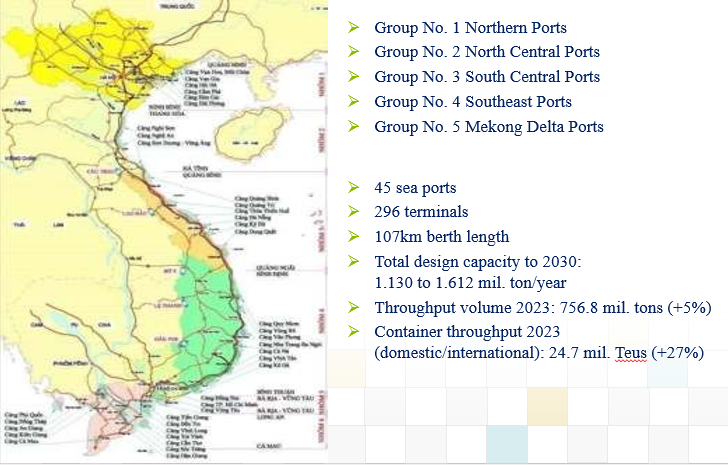
Vietnam’s seaport system plays an important role in supporting domestic transportation, international trade, and container shipping.
The profile presents the following seaport statistics:
- 45 seaports
- 296 terminals
- 107 kilometers of berth length
- 2023 cargo throughput: 756.8 million tons, up 5%
- 2023 container throughput: 24.7 million TEUs, up 27%
The country’s seaports are classified into five regional groups: Northern Ports, North Central Ports, South Central Ports, Southeast Ports, and Mekong Delta Ports.
3.1. Ports in Ho Chi Minh City and Southern Vietnam
The profile identifies several major ports and terminals in the Ho Chi Minh City area:
- Tan Cang Cat Lai Port
- Tan Cang Hiep Phuoc Port
- Vietnam International Container Terminal (VICT)
- SP-ITC Port
- Tan Cang Phu Huu Port
- Phuoc Long ICD Port
Tan Cang Cat Lai Port
According to the profile, Cat Lai Port has a total area of 160 hectares and an annual capacity of 6 million TEUs. Its berth length is 2,040 meters, with nine berths and one barge berth. The maximum vessel size listed is 45,000 DWT.
The terminal’s equipment includes STS cranes, RTGs, reefer plugs, reach stackers, and prime movers.
Tan Cang Hiep Phuoc Port
The profile lists a total area of 17 hectares and an annual capacity of 650,000 TEUs. The terminal has two berths and four barge berths, with a total berth length of 420 meters. Its maximum vessel size is listed as 50,000 DWT.
VICT Port
VICT has a reported area of 20 hectares and an annual capacity of 650,000 TEUs. The terminal has four berths with a total length of 678 meters and a maximum vessel size of 25,000 DWT.
SP-ITC Port
The profile lists SP-ITC Port with a total area of 48 hectares and an annual capacity of 2 million TEUs. Its berth length is 1,000 meters, and the maximum vessel size is 45,000 DWT.
Cai Mep International Terminal (CMIT)
CMIT is located in Ba Ria–Vung Tau Province, approximately 70 kilometers from Ho Chi Minh City. The profile identifies its location near National Highway 51 and describes a service arrangement in which full containers are handled at SP-ITC and transported by barge to CMIT. The associated barge cost is indicated as being under the principal’s account.
3.2. Ho Chi Minh City Port and Road Restrictions
The profile outlines road restrictions for container transportation in Ho Chi Minh City:
- 20-foot containers: Restricted from 09:00 to 16:00 and from 21:00 to 06:00 local time.
- 40-foot containers: Restricted from 21:00 to 06:00 local time.
The presentation also lists navigation-related information, including compulsory pilotage, a maximum air draft of 44 meters, and Saigon River draft and tidal conditions.
These details reflect the information in the profile and should be reconfirmed with the relevant authorities before operational use.
4. Ports in Hai Phong and Northern Vietnam
Hai Phong is an important maritime gateway for northern Vietnam. The profile identifies the following ports and terminals:
- Hai Phong International Container Terminal (HICT)
- Nam Dinh Vu Port
- Nam Hai Dinh Vu Port
- Tan Vu Port
- Chua Ve Port
- Hai An Port
- Doan Xa Port
- VIP Green Port
- Transvina Port
- Tan Cang 128 Terminal
- ICD Tan Cang Hai Phong
Hai Phong International Container Terminal (HICT)
According to the profile, HICT has a total area of 57 hectares and an annual capacity of 1.1 million TEUs. It has two berths and one barge berth, with a total berth length of 900 meters. The maximum vessel size is listed as 160,000 DWT.
Nam Dinh Vu Port
The profile lists Nam Dinh Vu Port with a total area of 42 hectares and an annual capacity of 1.2 million TEUs. The terminal has four berths with a combined length of 900 meters and a maximum vessel size of 48,000 DWT.
Nam Hai Dinh Vu Port
Nam Hai Dinh Vu Port is listed with a total area of 20 hectares and an annual capacity of 550,000 TEUs. Its berth length is 450 meters, and the maximum vessel size is 48,000 DWT.
Tan Vu Port
The profile lists Tan Vu Port with a total area of approximately 510,000 square meters and an annual capacity of 1.25 million TEUs. It has five berths with a combined length of 980.6 meters and a maximum vessel size of 40,000 DWT.
Tan Cang 128 Terminal
TC128 is described in the profile as a feeder terminal supporting HICT. Its listed total area is 16.5 hectares, berth length is 422 meters, and maximum vessel size is 15,000 DWT.
Cai Lan Port
Cai Lan Port is located in Ha Long Bay, approximately 60 kilometers from Hai Phong. The profile lists a wharf length of 2,715 meters, a maximum vessel length of 200 meters, and a draft alongside the berth of 7.5 meters.
The presentation also identifies Cai Lan and Hai Phong as two main port locations serving northern Vietnam, with Hanoi approximately 105 kilometers from Hai Phong.
5. Feeder Operations
The profile presents feeder operations from Ho Chi Minh City and Hai Phong, including outbound Singapore (SIN) and Port Klang (PKG) services.
5.1. Outbound Singapore Service
The Ho Chi Minh City service information includes feeder and joint-service arrangements involving MCC, OOCL, RCL, ACL, COSCO, SSL, Xpress Feeder, Evergreen, and Yang Ming.
The profile lists sailing days for several services, including Monday, Tuesday, Thursday, Saturday, and Monday–Tuesday, depending on the carrier and service arrangement.
It also identifies slot arrangements involving partners such as SOL, BTL, HPL, and CMA.
5.2. Outbound Port Klang Service
The outbound PKG service information lists COSCO, RCL, OOCL, Wan Hai, Evergreen, and Yang Ming, with service days ranging from Sunday to Thursday and Monday–Tuesday, depending on the carrier.
The profile also refers to slot arrangements involving ZIM, SOL, BTL, Xpress, RCL, IAL, and Sinokor.
5.3. Feeder Operations in Ho Chi Minh City and Hai Phong
For Ho Chi Minh City, the presentation lists feeder service arrangements involving ACL, SSL, MCC, YML, and Lotus Link, alongside running services and slot-buying arrangements for other carriers.
For Hai Phong, the profile presents outbound Singapore and Port Klang feeder connections, including feeder services and joint arrangements with various shipping lines.
Note: All carrier names, sailing days, and slot arrangements above are reproduced as general information from the 2025 profile. They are not a confirmation of current schedules or present-day service availability.
HOCHIMINH
|
OUTBOUND SIN SERVICE
|
|
MCC
|
Feeder service
|
Monday
|
SOL/BTL buy fix slot
|
|
OOCL / RCL
|
Joint service
|
Tuesday
|
|
|
ACL
|
Feeder service
|
Saturday
|
SSL buy fix slot
|
|
COSCO / SSL
|
Joint service
|
Monday
|
|
|
Xpress Feeder
|
|
|
HPL/CMA buy fix slot
|
|
Evergreen
|
|
Thurday
|
|
|
Yangming
|
|
Monday & Tuesday
|
|
|
OUTBOUND PKG SERVICE
|
|
COSCO
|
|
Sunday
|
|
|
RCL
|
|
Wednesday
|
ZIM/SOL/BTL/Xpress buy fix slot
|
|
OOCL
|
|
Tuesday
|
RCL/BTL bUy fix slot
|
|
WANHAI
|
|
Tuesday
|
IAL/Sinokor (Heung A) buy fix slot
|
|
Evergreen
|
|
Thursday
|
|
|
Yangming
|
|
Monday & Tuesday
|
|
HAIPHONG
|
OUTBOUND SIN SERVICE
|
|
ACL/SSL/MCC
|
Feeder service
|
SOL/BTL buy fix slot
|
|
YML/LOTUS LINK
|
Feeder service
|
Xpress buy fix slot
|
|
OUTBOUND PKG SERVICE
|
|
Wanhai/YML/Tameha/Evergreen
|
Running service
|
|
|
IAL/Xpress/BTL/SOL/…
|
|
Buy fix slot with VO
|
Conclusion
The AMSS profile provides an overview of Vietnam’s economy, international trade, free trade agreements, foreign investment, seaport infrastructure, and feeder operations.
From the major terminals in southern Vietnam to the ports of Hai Phong and Cai Lan in the north, the country’s maritime network supports the movement of containerized cargo and connections with regional shipping hubs.
Understanding port characteristics, operational restrictions, and feeder service arrangements is important for planning cargo movements and coordinating international shipping operations.